25.03.2015
"We do research for the medium-sized businesses." Prof. Dr.-Ing. Harald Goldau from the Magdeburg-Stendal University of Applied Sciences
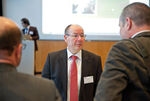
Haas Schleifmaschinen: Prof. Dr.-Ing. Harald Goldau - sought-after expert.
"We take care of production engineering and are a technology bridge for medium-sized companies."
For many years, the industrial laboratory "Innovative Manufacturing Processes" has enjoyed an excellent reputation in the field of finish and friction-welding technology. Prof. Dr.-Ing. Harald Goldau, Prorector for Research, Development and Technology Transfer at the University of Magdeburg-Stendal, heads the IL IFV. We met Professor Goldau for an interview on the occasion of a symposium on grinding technology and precision machining.
How do you achieve the ideal functional surface for the finishing of components, which results in less friction, better functionality and less energy loss? Professor Goldau and his colleagues in the "Innovative Manufacturing Processes" (IL IFV) industrial laboratory at Magdeburg-Stendal University of Applied Sciences are working on this and similar research questions.
Blog: Professor Goldau, how does your institute see itself?
Professor Goldau: The Institute of Mechanical Engineering at Magdeburg-Stendal University of Applied Sciences sees itself as a service and development partner for medium-sized companies in the automotive industry, their suppliers, medical technology and the fittings industry. It is very important to us to offer the right know-how and optimum technical equipment to companies that do not have sufficient opportunities for practice-oriented research themselves. In other words, we conduct research for medium-sized companies.
Blog: Please explain to our readers the main focus of the industry laboratory "Innovative Manufacturing Processes" (IL IFV).
Prof. Goldau: One of our main research areas is the finishing of components with the aim of getting as close as possible to the ideal, functional surface. This is because surfaces with a defined structure, shape and dimensional stability lead to less friction, better functionality and less energy loss. This applies to the sliding surfaces of a knee implant as well as to sealing surfaces on fittings and injection technology in the engine area.We are an institute with a strong practical orientation, which means that we mainly focus on the production technology of regional and national industrial companies. With our work we want to improve the production technology of our industrial partners. In particular, we focus on final processing and precision, whereby our development approaches always focus on the process as a whole. This means that the process begins with the blank and we want to develop an economically and technically good overall process for our customers. Whether for the manufacture of a fitting or the grinding of an implant.
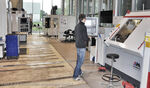
IL ILV Hochschule Magdeburg-Stendal: Research for medium-sized businesses.
Blog: How should we imagine the work of your team?
Prof. Goldau: Let's take a component from the automotive industry. For example, we have a project with a manufacturer of joints and sliding joints. These latest generation sliding joints are to become significantly lighter and smaller and have to absorb higher torques. We are announcing to the customer that we will achieve this goal with special finishing processes and modified materials, adapted geometries and surfaces. We attach particular importance to the finishing of these joints. As is often the case today, these parts are not yet finish-machined. Finishing by finishing (superfinishing, microfinishing) is the key to success here. We show the customer prototypical ways to achieve this goal. We believe that this sliding joint can be significantly improved by means of new finish technologies alone. We then see it as our task to develop this process.
Another example is the latest generation of injection systems, which today place very high demands on tightness and load-bearing capacity. This is accompanied by very high demands on the surface quality of the component. We are developing the technology of how the sealing surfaces of the future can be produced economically using new and improved finishing processes.
In medical technology, we are working on projects aimed at improving sliding surfaces. These sliding surfaces, for example on the knee implant, are strictly speaking bearings. And with these bearings, we want to produce the tribologically optimal surface so that the wearer of the implant can go about his or her everyday life without any discomfort.
We see ourselves as innovation drivers, if you like, especially in the practice-oriented development of new finishing technologies. Machining is one facet, measuring and evaluating the surface are further challenges.
Blog: How is your institute equipped with production technology?
Prof. Goldau: We concentrate our production technology for precision machining in a laboratory hall of 200 m². Our research environment with high-precision machines is located here. A Hembrug hard lathe, a Multigrind® five-axis grinding machine from Haas, then a completely servo-electric friction welding machine, which we developed ourselves. In addition, there are special machines in the area of finish technology; these are machines that have been specially "reconditioned" by us.And of course measuring systems, on the one hand with tactile coordinate measuring technology, on the other hand with optical measuring technology. The latter is particularly important to us, as much more information can be derived from the information content of a 3D representation. With optical metrology, we very quickly obtain specific information about current process states, which we then use to improve the process.

IL ILV Hochschule Magdeburg-Stendal: Research for medium-sized businesses.
Blog: Why a grinding machine from Haas Schleifmaschinen, and what is the Multigrind® CA used for?
Prof. Goldau: We wanted to have a grinding machine with which we could produce precision components such as those used in medical technology. After a thorough market research, we came to the conclusion that we would be well served with the Haas Multigrind® CA if we could afford it. It was clear to us that our work in the top precision segment would only be possible with a high-end grinding center. Accordingly, we then put all the levers in motion to make this investment possible. Nevertheless, we said that the standard Haas machine, as it stands, was not sufficient for our research.
Blog: Why?
Prof. Goldau: Every finishing process is a force-regulated process and therefore the forces first have to be measured. We talked to Haas and asked them to modify the spindle unit so that the forces that occur during grinding and finishing are measured directly - with the aim of using these measured values and findings to develop a new process variant, the "grinding and finishing process combination". We told the people at Haas how we wanted to integrate the piezo-controlled force sensor system, and Haas did an excellent job of implementing this.
The forces are used today for servo-electric force control for the finishing process on the grinding machine!
Blog: And with this Haas Schleifmaschinen machine you are now...
Prof. Goldau: Components from medical technology, automotive engineering and the fittings industry. We have already used the Haas machine for friction stir welding. We use it to join aluminium sheets, for example. Certainly not a standard application. We used the Haas machine because the force control works well. For us, this is a nice side effect because we can also use the Haas machine for basic tests of force-controlled processes.
Blog: Let us assume that friction stir welding will not be a main application of a high-tech grinding center in the future. What must a grinding machine be capable of in the future, also with regard to industry 4.0?
Prof. Goldau: With the modern machine control system, we automatically grow into the demands made on us by industry 4.0. We are giving mechanics more and more sensory functions through the ever improving control technology and digital drive technology. The result will be that we will make the machine more intelligent with the new control technology and integrate greater sensitivity into the systems. In the high-end sector, where even more precision is simply required, piezo-controlled force sensor solutions will help us develop new, better machining processes in the future. The networking of industrial plants within a company and between companies will become increasingly important. The responsibility of machine manufacturers and software developers for program exchange, maintenance and troubleshooting will grow significantly. However, not every user will have the same requirements as we now have for Haas machines. That is why we are placing a further emphasis on the development of precise and stable processes in the standard area.
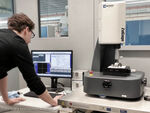
IL ILV Hochschule Magdeburg-Stendal: The finest measuring technology.
Blog: When you think of the surface qualities of the workpieces, which are supposed to be better and better, where is the development going?
Prof. Goldau: I don't want to say better, but more tribologically fitting! So it's not about finer or better surfaces, but about surfaces that are tribologically designed in such a way that they optimally fulfil the later functions on the component and for this very constant technological conditions have to be ensured and very narrow quality parameters have to be adhered to. This means that you can select or optimize all the individual elements of a process, i.e. tool, clamping device, workpiece, coolant and all boundary conditions in such a way that you get the functional surface right.
Blog: We talked about the role of machine control, about intelligent control technology. How do you see the role of software in machining or grinding?
Prof. Goldau: In modern machine tools with digital drive and control technology as well as integrated sensor and actuator technology, the software plays a decisive role in determining how customer requirements can be met. The hardware, i.e. all basic components of the machine tool, are the basis for solid mechanical engineering, but software is playing an increasingly important role. It is only with the software that intelligence enters the machine, whether in a turning or milling machining center, a special machine such as a friction welding machine, or a grinding center. For me, the overall complex of software includes: the design software, the grinding software, the operating software, the quality assurance software and the evaluation and documentation software. To put it in a nutshell, the software is intended to enable the machine to think and feel.
Blog: It is not far from the software to the 3D printers, which are currently seen as a panacea in manufacturing. Will 3D printers ever make machine tools and grinding machines superfluous?
Prof. Goldau: The manifold technologies of 3D printers enrich the possibilities of manufacturing technology, especially in the production of complex workpieces. I prefer to talk about 3D forming rather than 3D printing. For the development of a suitable process chain from raw part to finished part according to target parameters such as manufacturing quality, time and costs as well as resource efficiency, the machine tools for the main processes turning, milling/drilling and grinding in particular will retain their dominant role.In my opinion, we are still a long way from 3D printing being able to consistently meet our requirements in terms of material selection, accuracy and surface quality. 3D printing is another technology with a manageable application potential, but it will not replace machining processes.
Blog: How do you see the development of materials in machining?
Prof. Goldau: Three trends can be seen here. Increasingly, materials with higher hardness and strength properties have to be machined; then composite materials will require new machining technologies, and thirdly, coatings on surfaces will experience an expansion of their functional scope. For the final machining process, this means that the material is first given a defined geometry and certain basic properties. However, the functional properties only come with the coating and perhaps with additional finishing of the coating.
Blog: How do you see the German tool and grinding machine industry in an international comparison?
Prof. Goldau: In our laboratories of the Institute of Mechanical Engineering we only work with precision machines from Europe. In the tenders for our machine tools, the highest demands were placed on precision and flexibility, some of which go beyond the state of the art. Only a very limited number of machine manufacturers meet these requirements. From my point of view, the German machine tool industry has a good specialization, a high innovative power, is reliable and excellently networked and brings an extraordinary experience potential also with a view to the future. The economic figures also speak for the strength of the machine tool industry. As a university, we work very pleasantly and successfully with companies in the machine tool industry and their users in networks.
I see mechanical engineering in Germany as an important and very innovative industry, which always produces outstanding new technologies and products. This is why technological cooperation between machine tool manufacturers and users is so important for the further development of combination machining between grinding and finishing.
Blog: When we talk about the innovative strength and efficiency of German mechanical engineering, how do you see the farewell to the world-renowned "Diplom-Ingenieur Made in Germany" as a Bachelor's or Master's degree?
Prof. Goldau: Actually, I don't think that the two degrees Bachelor and Master, which are no longer so new, generally bother us. The people who want to become engineers are the same. We know that the Master's degree is practically not inferior to the qualification of the diploma. We know that the Bachelor's degree is shorter and therefore more responsibility lies with the companies when it comes to training. That is what the Bologna Process is calling for, and we must adapt to the pan-European conditions.
In my view, it is much more important for us in Germany to provide our universities with solid basic funding and, through a good research and development policy, to network the potential of universities, companies and institutions well. We should not be tying our technical level to the terms master's, bachelor's or diploma.
Blog: Do we come back to the topic of innovations? What engineering achievements in the last 100 years do you particularly admire as an engineer?
Prof. Goldau: I would like to concentrate on the area of machining: The development of cutting materials has created and continues to create new challenges. Must the cutting material be able to do more or is the machine tool in focus? 80 years ago, tungsten carbide brought a leap in productivity and quality, for 35 years and to this day it is tool coatings. In grinding it was the high-performance cutting materials diamond and CBN and adapted tool grinding wheels. Today we speak of tailor-made tools, tailored to technologies and processes.The cutting material must be able to be used successfully in the interaction of machine tool, clamping device, workpiece, tool as well as cutting auxiliary material and boundary conditions. A task that challenged the engineer 100 years ago and still does today in the same way.
Blog: What do you do if you do not deal with the optimal tribological surface? Where do you find balance and inspiration?
Prof. Goldau: I find a balance between my job and my family on the one hand, and sport on the other: running, swimming or cycling. But I must also say quite honestly that work is a hobby for me in a way, I like to think about the further development and improvement of processes, machines and plants.
Blog: Professor Goldau, thank you for the interview!
You, dear readers of the Blog, have the opportunity to personally experience and get to know Professor Goldau. On the occasion of the event GrindDate - Schleiftechnologie im Dialog (April 24/25, 2015) Professor Goldau will speak to us in Trossingen about "Measuring process forces during grinding".
If you would like to comment on the interview, we look forward to receiving your suggestions, ideas or questions. You can simply use the comment function. Or send me an email.
See you soon.
Thomas Bader
The author

Dirk Wember
Managing Director
Dirk Wember is an enthusiastic pilot, passionate engineer and managing director of Adelbert Haas.
Share article


Comments (0)
Write a comment