06.09.2013
Genuine sustainability instead of empty phrases
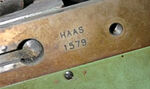
Edelsteinschleiferei HERBERT FRANZMANN e.K.: HS 1.
Planned wearout?
Maybe you also know this: you buy an electrical device, you use it for a while and then, the warranty has just expired, the thing gives up the ghost. A rogue who thinks evil, isn't he? In the spring of this year, a small study on this subject was published in which 20 mass-produced products were tested.
The study "Planned Obsolence" was carried out by Stefan Schridde and Prof. Christian Kreiß from Aalen University. According to Kreiß, the phenomenon of planned obsolescence (planned wear and tear) is an American one and arose in the early 1920s when GM successfully attacked its competitor Ford with a new design, rapid model changes and clever marketing. The thoroughbred engineer Henry Ford was a fanatical supporter of quality, durability and absolute integrity of the product. Ford was successful with his "Model T" until GM came up with a new strategy and deliberately reduced the durability of the cars. Why? To sell more cars in shorter cycles.
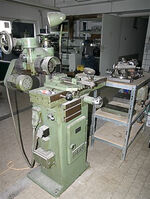
Edelsteinschleiferei HERBERT FRANZMANN e.K.: HS 1.
Built-in sustainability!
Henry Ford and our company founder Adelbert Haas probably got along very well. Like Ford, Haas was a thoroughbred technician and quality was his top priority. So it's no wonder that there are customers who still work with our grinding machines from the sixties today.
Recently I received an e-mail from a long-time customer in Idar-Oberschein. Werner Fürstenberg-Franzmann from the gemstone company HERBERT FRANZMANN e.K. bought his first Haas grinding machine around 1967 from Adelbert Haas and transported the machine with the trailer to Idar-Oberstein. There, the HS 1 is still in use today alongside three other Haas grinding machines. Werner Fürstenberg-Franzmann kindly sent me some photos and allowed me to quote from his e-mail:
Purchase of grinding machines in 1967
"That's when we decided to buy an HS 1. Adelbert Haas asked: "Where are you from?" "We're both from Idar-Oberstein." "And what do you do for a living?" "We are gemstone cutters." "Yes, what can you do with a HS 1?" "It's very simple: Edit gemstones." Haas was amazed by our idea. After he had explained his machine to us, and we told him what else we wanted to do with the machine, it was clear to him: the machine will come in new honors. After hours of stimulating shop talk, we loaded up the machine and drove back to Idar-Oberstein.

Haas Schleifmaschinen: The spirit of Adelbert Haas Werkzeugmaschinenfabrik.
On the way home, my cousin and I talked for a long time about the abilities of Mr. Haas and both thought he was an ingenious inventor. That's why I'm still proud to own one of his machines. We already admired this quality back then. Today I would like to ask: Where else can you find machines that last 30 years and longer?
Meanwhile we have three HS 1 machines in our company as well as a CNC HS 325, also from Haas, which has been running for 27 or 30 years. That's why we are so enthusiastic about Haas". (Original e-mail available)
So much for us today on the subject of sustainability, which will soon play a major role again at EMO. It goes without saying that the spirit of our company founder still prevails at Haas Schleifmaschinen. Even though we like to sell a new grinding machine, we are proud of Haas Schleifmaschinen that have been tirelessly doing what they are supposed to do for decades: delivering excellent grinding results.
If you have also been using a Haas Schleifmaschinen for many years, send us a photo if you like. We'll bring it here in the sanding blog.
With this in mind: Grinding with attitude!
PS: I did some quick research: the HS 1 is still traded in used machine exchanges!
The author

Thomas Bader
Managing Director
Thomas Bader is an enthusiastic aerobatic pilot, engineer with heart and soul and managing director at Adelbert Haas.
Share article


Comments (0)
Write a comment